How is our world changing?
Modern industries, economies, cultures, governments, and information are becoming globalized at an astonishing rate. Globalization is a term used to describe the increasing connection and interdependence of world cultures and economies. Fueling this globalization are the technological advancements we have experienced in the last 30 years, which have completely re-shaped existing business and have created new careers that were never previously imagined. Anyone with an internet connection has access to an infinite amount of information to gain knowledge, start a business, share ideas, and communicate with people from all over the world. Thomas Friedman states in his discussion on his book The World is Flat how several events, technologies, and businesses created a global platform for people to conveniently collaborate. He comments that globalization is no longer controlled by countries or businesses, but can now be shifted by individual people and small groups from anywhere in the world.
What impact will this have on education?
The advances in technology have an immeasurable potential in educating populations. The ability to instantly share information through the internet and conduct collaborations with anyone in the world creates a reality where an education can be available to all. People no longer have to be physically present to attend a class or to hear a lecture. Educators and schools have access to limitless lesson plans and new tools for teaching with the use of technology. However, this requires funding to be appropriated to school’s technological infrastructure so that education can achieve the full benefit of the global platform. One of the ways to convince governments to invest in technology in schools is to argue the necessity to educate our future employees (today’s students) to compete in the global economy. How will we remain a contender if our education is substandard? We must also consider how to educate students to be successful in jobs that do not even exist yet. Friedman describes an example of a present-day career in “search engine optimizing”. Obviously, someone 30 years ago could not have known exactly how to educate someone for this career because there was no such thing as search engines. Our society must insist on educating our students to be creative, open-minded, tech-savvy collaborators in order to succeed in the future global economy.
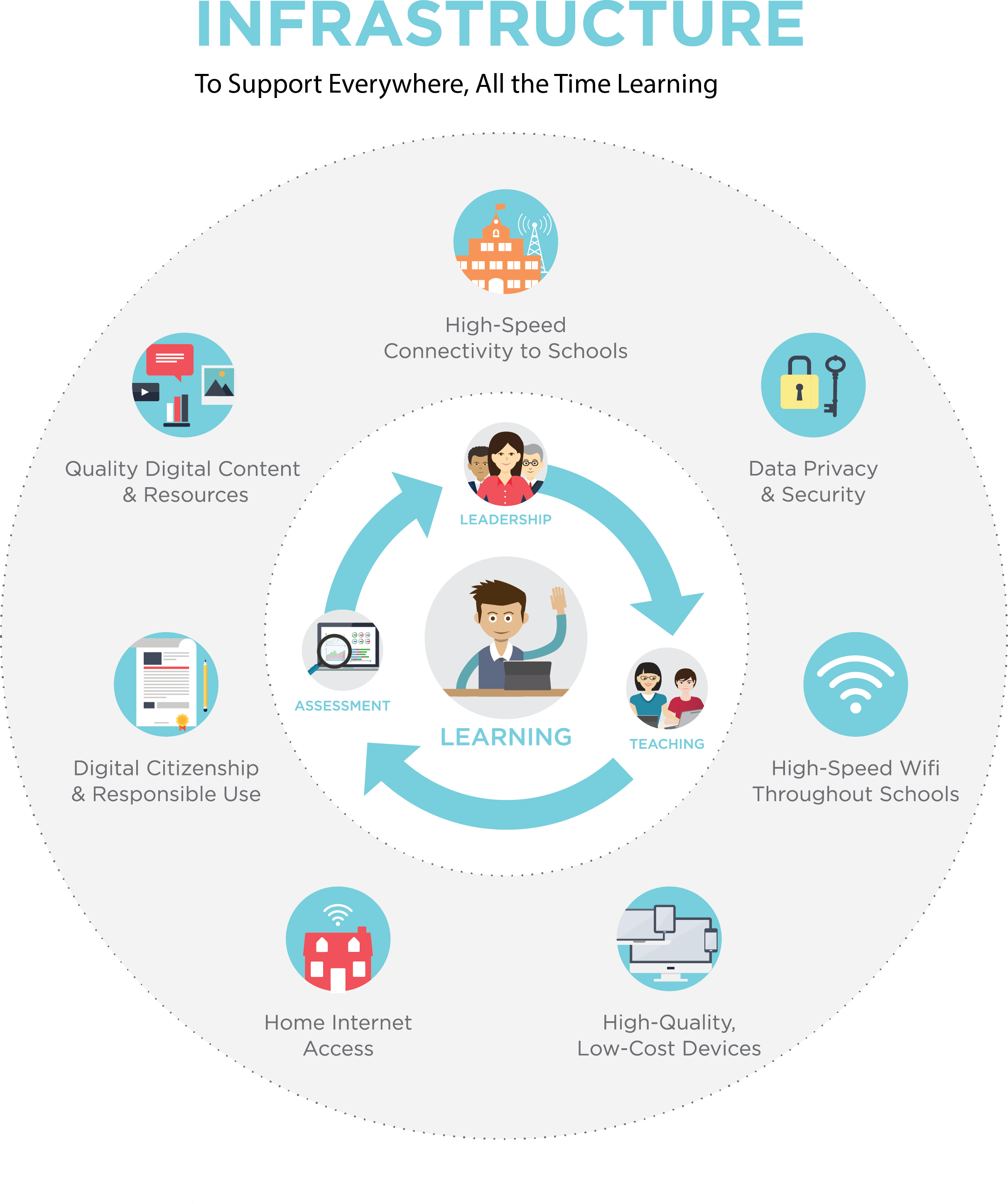
I found the following information useful in explaining and illustrating how access to technology should be structured for students and schools; this excerpt was obtained from the Office of Educational Technology website, https://tech.ed.gov/netp/infrastructure/ :
Preparing students to be successful for the future requires a robust and flexible learning infrastructure capable of supporting new types of engagement and providing ubiquitous access to the technology tools that allow students to create, design, and explore. The essential components of an infrastructure capable of supporting transformational learning experiences include the following:
- Ubiquitous connectivity. Persistent access to high-speed Internet in and out of school
- Powerful learning devices. Access to mobile devices that connect learners and educators to the vast resources of the Internet and facilitate communication and collaboration
- High-quality digital learning content. Digital learning content and tools that can be used to design and deliver engaging and relevant learning experiences
- Responsible Use Policies (RUPs). Guidelines to safeguard students and ensure that the infrastructure is used to support learning
What evidence do you see in today’s classrooms of these global shifts?
Today’s classrooms do incorporate technology into lessons, and there is a movement for more science, math, and tech lessons in schools associated with the STEM programs. The skills taught in STEM programs will prepare students for future digital and tech careers in the global market. I do believe these programs should be available to all students nationally. It seems that some schools adopt STEM programs more than others. There are also lessons on digital responsibility in most schools, which is due to the shift in the everyday use of technology. This curriculum is necessary to teach children how to stay safe while using the internet, how to protect their identity, and how to be responsible about sharing information that could potential harm themselves or other children.
How will globalization shifts affect you as a future teacher?
Although I do not particularly agree with the ideology of capitalism and globalization, I cannot deny that globalization is part of our society and the driving force of a large part of our economy. As a future teacher, I will recognize that my students will be the future innovators and contributors to globalization efforts. I support STEM programs and plan to incorporate them into my class lessons. I aspire to continue my knowledge and education of changes in industries and technologies and hope to adapt them to meaningful instruction for my students. I also plan to present tools and programs to my students so they have an option to excel their growth. One such program is Girls who Code. I plan to socially prepare my students for global shifts by allowing them to focus on their collaboration skills, communication, and creativity through group projects and student-centered classroom environment. I believe these skills will ensure their success in their future endeavors.

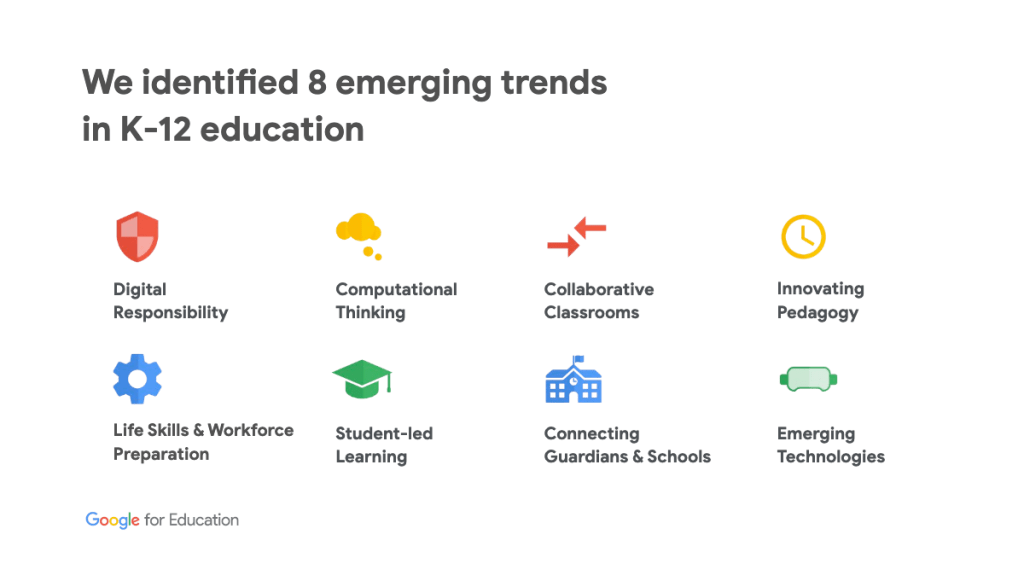
The Google for Education website has a nice presentation on how shifts are occurring in classroom education around the world. Here is one of the pages and the link to whole report:
Resources:
-Google for Education, Future of the Classroom, Retrieved from https://edu.google.com
-Office of Educational Technology, Infrastructure, Retrieved from https://tech.ed.gov
 Trisha's University Blog
Trisha,
There are many great points regarding technology in the classrooms and globalization in your post. One truly important point is for America to remain a contender in education. As Americans we need to change our focus, and pay attention to the things that really matter. By this I mean that the same thing we are asking for our children to have in their classrooms, it’s the very thing that is taking our time away from what we need to focus on. Not sure if it’s just me, but I feel that most Americans are too concern with materialistic things, including technology, and we see it more as convenience and luxury rather than to improve our intelligence; the way people in other countries who are starving for an education would use it for.
Great post Trisha,
Zugey
LikeLike
Hi Trisha, I liked that you brought up STEM programs in your post. As you said skills you can learn in STEM programs are beneficial for students who want to go into digital and tech careers, and those skills can also be beneficial for all parts of life. Technology is always changing and expanding, learning how to adapt if important. The idea of teaching digital responsibility is important as well. With social media today it is even more imperative that we teach our children how to be safe with using the Internet. Great post!
LikeLike