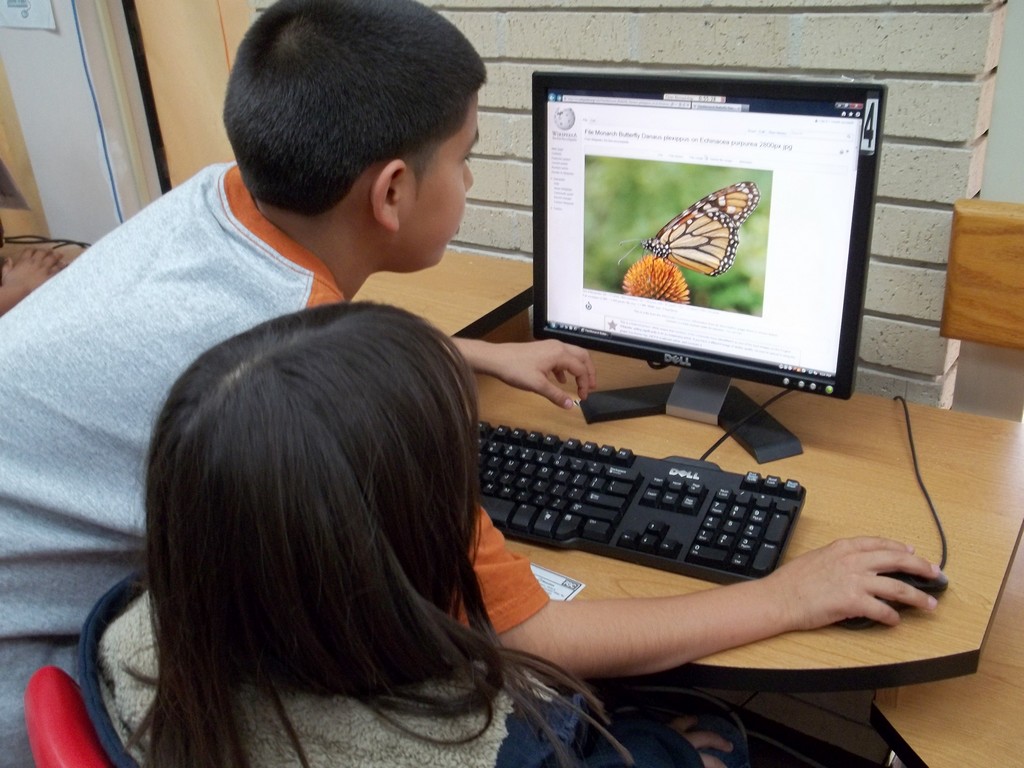
The TED talks by Sugata Mitra discussing his method of discovering how children will learn even with limited resources and minimal to no instruction, and his vision for The School in the Cloud is simultaneously intriguing and counter-intuitive. I was captivated when Mitra states, “Children will learn to do what they want to do.” It is true that children have a natural desire to learn and problem-solve, and they will attempt to do so given the right tools and resources. Therefore, if the tools and resources are more advanced, then the children will be able to learn at a faster rate and with greater complexity. Technology and access to the internet is the resource children need to answer any question or solve any problem presented to them. The counter-intuitive portion of Mitra’s findings are that children can do this primarily on their own, without a teacher’s constant instruction and guidance. The majority of schools in our society are teacher-centered and require a teacher to guide students through lessons on a daily basis. Mitra is proposing the idea of schools that are student-centered and require little teaching. His method has been implemented in areas of the world where there are limited quality-teachers and inadequate technological resources, and it has been a successful platform.
Mitra argues that our school system is out-dated and needs to be re-envisioned. I agree that our classrooms should shift to a student-centered method and that teachers can be present to guide the students with limited direct instruction. It is my position that a teacher’s main role is to facilitate a productive environment for learning, and this is how I intend to teach in the future. Students become more engaged in class when they are an active participant in the curriculum. I believe children achieve more when they are using their imaginations and learning through doing. It is essential for students to contribute to classroom structure and their learning goals because it instills a sense of responsibility and self-awareness. Mitra’s findings are validation that children should be allowed the space to learn independently and with one another, and to freely collaborate with their classmates.
I was curious about The School in the Cloud, so I went to the website, and I was surprised to see the amount of S.O.L.E’s (Self-Organized Learning Environments) across the world. Unfortunately, there are none in Los Angeles, or California for that matter. The “Big Questions”, which are the questions presented to the children within the S.O.L.E’s are complex and difficult to answer! The School in the Cloud website is a sufficient resource for lesson ideas and questions for student-reflection. A few of the questions I found compelling were:
What is empathy? What is narcissism? What role do they each play in effective communication?
Why do humans commit the same errors (in terms of the environment or society or politics) again and again?
How can I be autodidact?
 Trisha's University Blog
I completely agree with your description of a teacher being a facilitator of a productive learning environment. If we can create space for children to learn and discover, it can be kind of like the self-instruction Mitra was discussing. I also when to the school in the cloud website and it was so amazing to see all the places using this method.
LikeLike
Like Friedman said about Education being stuck the old ways of the Industrial era. Technology has changed how we teach now and given us more resources for teaching. i agree with the student centered method letting students do stuff on their own and teachers taking the role of a facilitator. When students have the time and space to collaborate with their classmates, they more likely to be engaged in their learning. Students will have a sense to make more of an effort in their work.
LikeLike