Biography- Lincoln

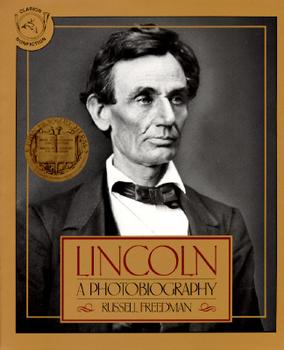
Freedman, R. (1987). Lincoln a photobiography. New York, NY: Clarion Books.

Age Recommendation: 11 years+

Response

Abraham Lincoln is one of the most popular Presidents for good reason. His life is the epitome of pursuing the American Dream. He was born as a rural country boy with humble opportunities. Lincoln’s passions, hard work, and tenacity led him to a life of great achievements and to the presidency. He faced adversity and fought for better values in our country. We all know the basics of Lincoln: he supported the emancipation of the slaves during the Civil War, he was known as “Honest Abe”, and he was the sixteenth President of the United States. Lincoln A Photobiography provides us with more information on Lincoln’s entire life, the surrounding events that led to the Civil War, his personal life, and his assassination. I was fascinated when I read this biography! There were numerous facts that I never knew about Lincoln. First, he had four sons, and two of them died at young ages due to illness. Lincoln had no real formal education, he was self-taught and a lawyer. He was opposed to the war against Mexico. I learned a great deal from the books explanation of how the different political parties approached the issue of slavery, how the Civil War began, how it was fought, and why it occurred.

I grew up in Redlands, CA, which is the location of a Lincoln Memorial Shrine. It is the only museum dedicated to Abraham Lincoln on the west coast. I have attended the memorial several times since I was a teenager. I recall feeling in awe of the striking bust statues, photographs, and paintings of Lincoln at the memorial as a young adult. After reading Lincoln a Photobiography, I have more insight into his life, ideologies, and accomplishments, and now I am in awe of him as a human being.
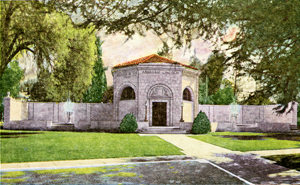
Lincoln Memorial Shrine in Redlands, CA

Critique

It is my experience, and I am sure the experience of many others, that biographies can be difficult to read. Sometimes they contain too many facts and brief descriptions of events without enough riveting details. Lincoln A Photobiography, captures the essence of Lincoln as a great man and president through personal accounts of his life and photographs to provide context. The quotes and excerpts from Lincoln are powerful and help add to the depiction of Lincoln’s convictions. The photographs will also engage students who are visual learners. The book is written as an informative text, but there are times when you are drawn into the stories of the battles and the people involved without feeling lost in mundane information. The author spends adequate time explaining each time period of Lincoln’s life and legacy.

Lesson Sketch

Writing Lesson: After reading Lincoln a Photobiography, students will create a visual timeline outlining Lincoln’s life with at least 10 events including dates, a brief explanation of each event, and references to persons involved.

CCSS.ELA.RI.6.2: Determine a central idea of a text and how it is conveyed through particular details; provide a summary of the text distinct from personal opinions or judgments.

Art Lesson: After reading Lincoln a Photobiography, students will make a collage illustrating the events, struggles, and/or accomplishments of Lincoln’s life with at least two mediums and measuring at least 8 x 10″.

CCSS.VA.6.2: Students apply artistic processes and skills, using a variety of media to communicate meaning and intent in original works of art.

EXAMPLE:

“Women and Girls”, from transportation.gov

Discussion Questions: What did you learn about the historical events that took place during Lincoln’s life? How do you think these events shaped our country?

Resources

Lincoln Memorial Shrine

Lesson Planet- Abraham Lincoln Lessons

Abraham Lincoln Online- Lessons

YA Novel- The Hate U Give

Thomas, A. (2017) The hate u give. New York, NY: Balzer + Bray.

Ages: 14-18 Grades: 9-12

Response

Saying this is an amazing book is an understatement. This is THE book that should be read by every young adult and adult right now in our current social climate. Police brutality and racism are at the forefront of current social injustices. People are joining forces and protesting the disproportionate abuse against people of color and minorities by police. The inequalities in racial treatment are disgusting and should not be ignored any longer. This book just might help wake up a lot of people who do not understand why the Black Lives Matter movement has gained popularity. The books messages are heart wrenching and blatantly honest. Young men and women are dying at the hands of police officers because of the color of their skin. The novel honestly depicts racial profiling, the differences in upper and lower class mindsets, attitudes towards the police, gang violence, the right to peacefully protest, and how murder at the hands of those meant to serve the community is tragic. Every citizen should take a long look at themselves and analyze how they can help improve the situation. Solidarity is crucial. Silence is part of the problem. Demand transparency! Stand up for what is right. Protest!

No Justice No Peace!

Critique

The novel centers around the life and events of a sixteen-year-old black woman, Starr Carter. She is faced with many challenges: she witnesses her friend’s unjustified death by a police officer, she lives in a predominately low-income, black neighborhood but attends a private school with upper class, mostly white students, she is afraid to speak out on the death of her friend due to gang threats, her friends cannot identify with her situation, and she is attempting to find her unique voice. The reader will enjoy experiencing how Starr grows from her adversity and finds the words she wants the world to hear. Angie Thomas writes her dialogue in a realistic tone, including slang and references that emerge from American black culture. Reading this novel can be a tool to gain empathy by connecting to some of the sad realities that many minority youth face in our society.

Lesson Sketch

After reading The Hate U Give, students will select a social injustice or inequality with which they identify or find important to research and prepare an informative 3-5 minute oral and physical/digital presentation based on a written narrative, evidence, and arguments from their perspective .

Suggestions to enhance the presentation: create a protest sign, show images supporting the selected movement, think of ideas on how to approach the problem, research non-profits that support the movement, find ways to get involved, write a letter directed to local city council members, write and recite a poem on the subject, or create artwork to present to the class.

Discussion Questions: What does social injustice or inequality mean? Can you describe any in our society? How can we change these inequalities?

11th and 12th Grade:

CCSS.ELA.W.4: Present information, findings, and supporting evidence (e.g.,reflective, historical investigation, response to literature presentations), conveying a clear and distinct perspective and a logical argument, such that listeners can follow the line of reasoning, alternative or opposing perspectives are addressed, and the organization, development, substance, and style are appropriate to purpose, audience, and a range of formal and informal tasks. Use appropriate eye contact, adequate volume, and clear pronunciation. a.Plan and deliver a reflective narrative that: explores the significance of a personal experience, event, or concern; uses sensory language to convey a vivid picture; includes appropriate narrative techniques (e.g., dialogue, pacing, description); and draws comparisons between the specific incident and broader themes.

Resources

Black Lives Matter

DC Educators for Social Justice

Black Lives Matter at Schools

WeekOfActionHowToParticipateNational

A Game for Swallows-Graphic Novel

Cover art by Zeine Abirachad

Abirached, Z. (2012). A game for swallows: to die, to leave, to return. Minneapolis, MN: Lerner Publishing Group, Inc.

Age Range: 12 – 18 years
Grade Level: 7 – 12
Lexile Measure: GN680L

Response

War is polarizing. It ruins lives, kills, and destroys. Ironically, it can also bring people closer together as they support each other to survive the hardships of war. Abirachad’s autobiographical graphic novel, A Game for Swallows, is a perfect depiction of how friends and family endure war and carry on to the best of their abilities. The novel is illustrated primarily in striking black images with white outlines. The social and emotional affects of war can be felt through the bold illustrations and simple text. The story takes place over one night where a group of neighbors are hunkering in a small space to avoid the bombings right outside. They have all lost something during the war, whether it be their homes, jobs, school, or loved ones. Some are looking for a way to escape to battle-free countries and others are trying to make the best of the situation. Not only is this an important story to be told, but the style of Abirachad’s illustrations are powerful and should not be missed.

empty street

Critique

The author primarily writes from the point of view of her younger self. There are times when you feel the innocence of a child’s perspective. Even though bombs are crashing right outside their home, the children still want to play and eat their favorite dessert. However, the back stories of the characters allow you to see a point of view that is not from a child. These insights into the past are a distinct contrast to the lives the neighbors are currently experiencing. They were models, architects, french teachers, night club owners…but now they are all simply trying to make it through one more night. It was a genius artistic decision to illustrate the novel entirely in black and white because it masterfully portrays the dichotomy of war.

Lesson Idea

After reading A Game for Swallows, students will complete a detailed cultural representation diagram of the similarities and differences in their culture and the culture represented in the novel with written comparisons and black and white illustrations.

Standards for 8th grade:

CCSS.ELA.W.9: Draw evidence from literary or informational texts to support analysis, reflection, and research.

CCSS.EL.RL.1: Cite the textual evidence that most strongly supports an analysis of what the text says explicitly as well as inferences drawn from the text.

Discussion Questions:

  • What details did you notice in the illustrations?
  • Which character did you relate to and why?
  • Did you notice any cultural elements that are different or the same as your life?

Resources

Cultural Representation Diagram Example

Teaching Books Guide to A Game for Swallows

Learn More Beirut Culture

Soldier Bear- Batchelder Award

Cover Illustration by Philip Hopman

Dumon Tak, B. (2008). Soldier bear. Grand Rapids, MI: Eerdmans Books for Young Readers

Age Range: 8 – 12 years
Grade Level: 4- 6

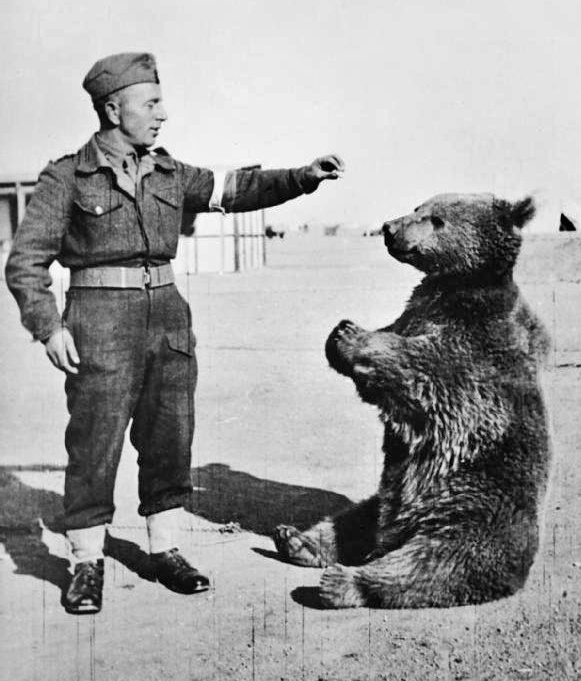
Soldier with Voytek (Wojtek) from Wikipedia

Response

I do not usually enjoy reading war-time stories, however, Soldier Bear was a pleasant combination of mischief, humor, and the sobering consequences of war. The story, which is based on true events, takes place during WWII and follows a group of Polish soldiers as they travel south from Poland, through the Middle East, and then to Europe to join forces in the fight against Germany. What sets this story apart from other WWII narratives? Well, the soldiers purchase a bear-cub while they are in the Middle East, and the reader has the pleasure of seeing how the bear is raised by the soldiers, gets them in trouble, gets them out of trouble, and how the bear becomes an honored soldier in his own right.

Critique

Soldier Bear is an appropriate novel to introduce the history of WWII without being too graphic or focused on the violence. Students will appreciate the likableness of Voytek the bear and the other animal characters in the story. It is enjoyable to read a novel where a bear is one of the main characters in a realistic presentation rather than in a fantasy- style where the bear has thoughts or dialogue for the reader. The soldiers do become the voice for Voytek and usually make accurate predictions on what the bear is thinking. The character dynamics are also interesting throughout the novel because they change, develop, and strengthen in unpredictable ways; including the dynamic between the animals.

Lesson Idea

After reading Soldier Bear, I think students should integrate the reading with researching history. Students will conduct research in groups of three to find additional information on Polish soldiers, the routes they traveled in the novel, Syrian brown bears, and the history of Voytek(Wojtek). Each group will present their findings to the class in a digital presentation.

Students will also complete a character dynamic activity. They will select two characters, then compare how the two characters interacted throughout the novel, how their relationship changed or grew, and details of the specific events when the characters interacted.

Discussion Questions:

  • Why do you think the soldiers decided to buy and raise Voytek the bear? Would you have taken the bear?
  • What were the negative and positive affects of the war on the soldiers and Voytek?
  • How did all of the soldiers and animals get along? What about the other soldiers and staff on the bases?

CCSS.ELA-Literacy.RH.6-8.7
Integrate visual information (e.g., in charts, graphs, photographs, videos, or maps) with other information in print and digital texts.

CCSS.ELA-Literacy.RL.5.3
Compare and contrast two or more characters, settings, or events in a story or drama, drawing on specific details in the text (e.g., how characters interact).

Resources

Publisher’s Study Guide: Lesson Ideas

Activity Village: Information on Voytek

Challenged Book- Bridge to Terabithia

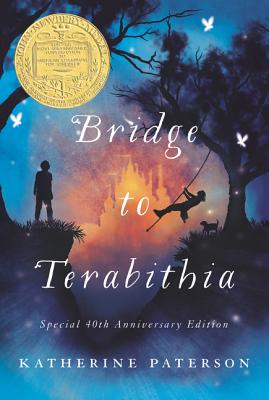
Cover art by Donna Diamond

Paterson, K. (1977). Bridge to Terabithia. New York, NY: HarperCollins.

Age: 12 & Older; Grade: 6-8; Lexile Measure 810L; Genre: Fiction

Response

Bridge to Terabithia is an emotional and inspiring coming-of-age novel that promotes following your dreams, being oneself, making close friends, and how to overcome the struggles of growing-up. Even with all of these positive messages and themes, the book has been challenged and banned due to profanity, the promotion of witchcraft, violence, and the negative portrayal of religion. The reasons for banning this book seem ridiculous while you read the story. This novel has much to offer the young reader and should not be banned from any reading list. The friendship between Jesse and Leslie is captivating and relatable. Gender-roles are questioned and broken- down, which is a relief to read in a novel written over 40 years ago. I believe the so-called witchcraft would be considered fantasy and childhood imagination by today’s standards.

Critique

The story is written from the point of view of Jess, who is a farm boy entering the fifth grade. He has many struggles in his life, including chores and household responsibilities, a dysfunctional family-life, a disapproving father, an artistic ability that is not appreciated by his family, and trouble making friends. The reader experiences the positive changes that happen to Jesse when he becomes friends with Leslie, an open-minded, free-spirited girl from the city. The plot revolves around the changes occurring in Jesse’s life and how he is maturing from childhood into adolescence. Leslie is the catalyst for many of Jess’ development and self-realizations.

The story has two main settings, the school in a rural area and an impressive imaginary place, Terabithia. The settings contrast each other drastically and further represent the struggle of Jess’ outside life with his creativity and fantasy. Jess and Leslie create resolution of their real-life problems by confronting them and overcoming them in their imaginary world.

Lesson Idea

Objective: After reading Bridge to Terabithia, students will be able to describe the plot of the story, analyze character traits, and evaluate how the characters develop while the plot unfolds with 80% accuracy.

  • CCSS.ELA.Literacy.RL:6.1 Cite textual evidence to support analysis of what the text says explicitly as well as inferences drawn from the text.
  • CCSS.ELA.Literacy.RL:6.3 Describe how a particular story’s or drama’s plot unfolds in a series of episodes as well as how the characters respond or change as the plot moves toward a resolution.

Discussion Questions:

  1. What are the qualities of a good friend? In what ways do Jess and Leslie display these qualities?
  2. What are the external and internal conflicts in Jess’ life? What type of struggles do the characters experience in the story?

Lesson Activity:

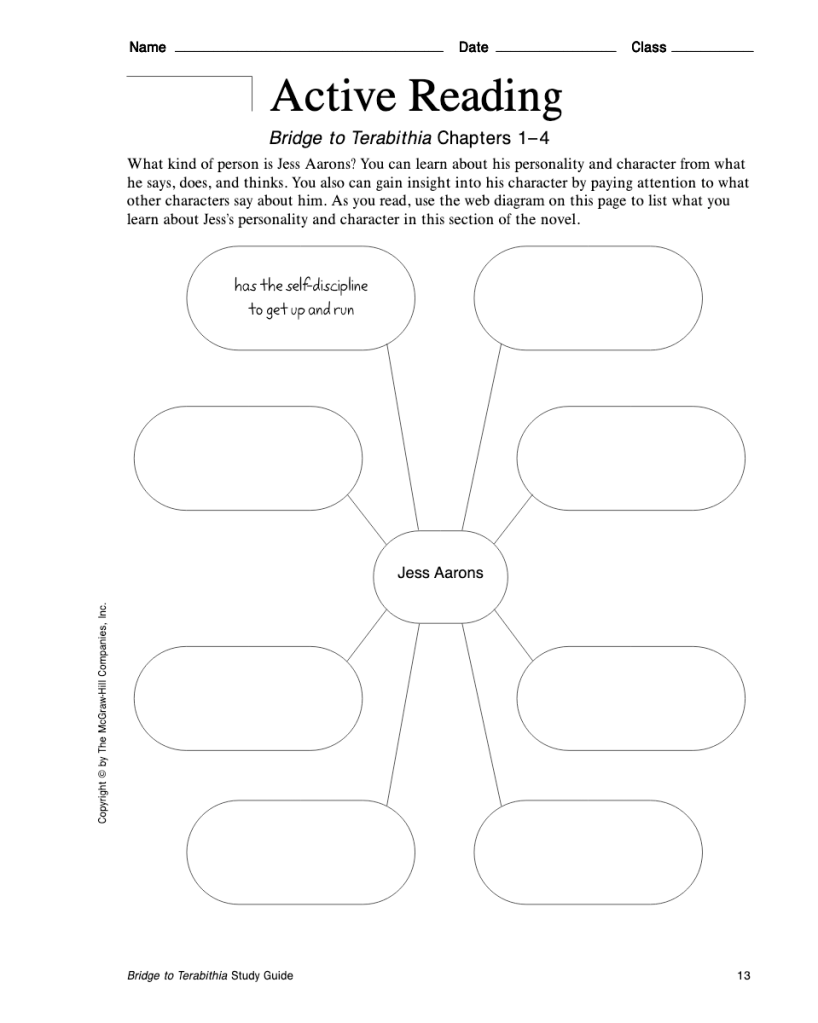
Complete a character diagram describing the personality and attributes of three main characters in the novel. Pick one of the characters and write a one page evaluation of how their personality and traits change or develop throughout the story. Provide specific examples of the events surrounding the character’s change.

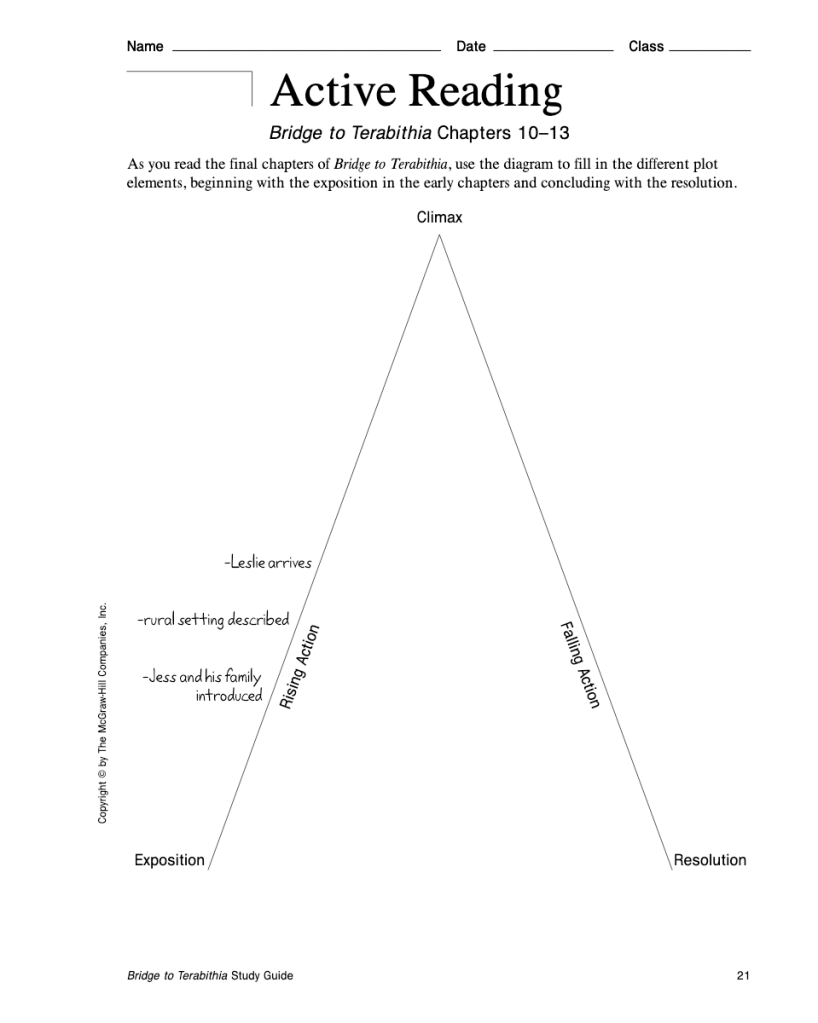
Study Guide for Bridge to Terabithia by Glencoe Literature Library

Create a Plot Triangle where you list the events during the exposition, rising action, climax, falling action, and climax of the story.

Resources

Scholastic Lesson Idea

Vocabulary List for Each Chapter

Study Guide for Bridge to Terabithia

Cultural Diversity in Children’s Literature

Cover of Wonder, Illustration by Tad Carpenter

Palacio, R. (2012). Wonder. New York, NY: Random House, Inc.

Age Range: 8 – 12 years
Grade Level: 3 – 7
Lexile Measure: 790L

Response

Millions have agreed, this novel is a pure delight to read and an emotional revelation for the reader. It is not everyday we are submerged into the perspective of a young boy who is living with a facial deformity that is noticed by every person he encounters. I was intrigued by Auggie’s, the protagonist, emotional and psychological responses to the rude looks, whispers, repulsion, and judgment experienced in his daily life. Every time Auggie noticed a stare or negative reaction to his physical appearance, I began to think about what it might feel like to be Auggie and if I have ever been that staring eye to someone. The feelings of being self-conscious, defensive, or judged by appearance are all ones with which we can identify; but not many have experienced the level of attention Auggie receives in the story.

The subject of disablilities and physical deformities can be challenging subjects to explore with students. The story of Wonder touches on the insensitivity and reactions people can have towards differences in physical appearances or abilities. This novel is an amazing tool to: introduce the subject of physical diversity; be an example of how people’s reactions can be harmful or helpful; how to be a more empathetic and accepting person; and, to consider the perspectives of people involved within a diverse life experience.

Critique

The story follows the trials and tribulations of Auggie while attending school. I loved how Auggie was a multi-dimensional personality that displayed bravery and admitted his fears. Each character has their role in supporting Auggie in his endeavor of being a first-time student. Some figures act as Auggie’s opposition, which also helps him overcome his worries and gain self-confidence. Auggie’s friends (Jack & Summer), sister, parents, educators, and classmates take action to ensure Auggie succeeds.

Wonder is distinctive from other novels because it has separate chapters where different characters provide their perspective on the events. We have the opportunity to see how each character views the main character, Auggie, and how they feel and view the current situation. The story is told primarily by the main character, Auggie, but it is a pleasure to read from the point of view of several people within the novel. This allows the reader to gain a broader understanding of what life feels like for someone that is close to a person with a physically diverse appearance.

Lesson Idea

Objective: After reading Wonder, students will exhibit their understanding of the themes and content of the story by writing three poems where each poem highlights a different character, writing a precept such as Mr. Browne’s, and by performing a scene from the story.

POEMS: Instruct students to write 3 poems; each poem is written about or from the perspective of a different character.

PRECEPT: After discussing the precepts throughout the novel, ask the students to write their own precept and share with the class.

PERFORMANCE: Working in small groups of 2-5 students, each group will select a scene from the story, decide who will play which character, practice for 2-3 days, and then perform the scene for the class.

Common Core Standards- Reading Literature: Key Ideas and Details: RL.5.1 and RL.5.3; Speaking and Listening: Comprehension and Collaboration: SL.5.1; Language: Conventions of Standard English:L.5.1.

Common Core State Standards- Writing: Text Type and Purposes W.5.1

Discussion Questions:

What are the qualities of a good friend? Which characters were a good friend to Auggie and why? Which characters were not and why?

What challenges did the characters face and how were they able to overcome these challenges? Consider how you might react if you were Auggie? Via? Jack? Julian?

Resources

Official Website for Wonder- teacher resources, more information on the text, interview with author, purchase info.

Give the class an overview of Treacher-Collins Syndrome using information from the following website: https://ghr.nlm.nih.gov/condition/treacher-collins-syndrome

Caldecott Winner

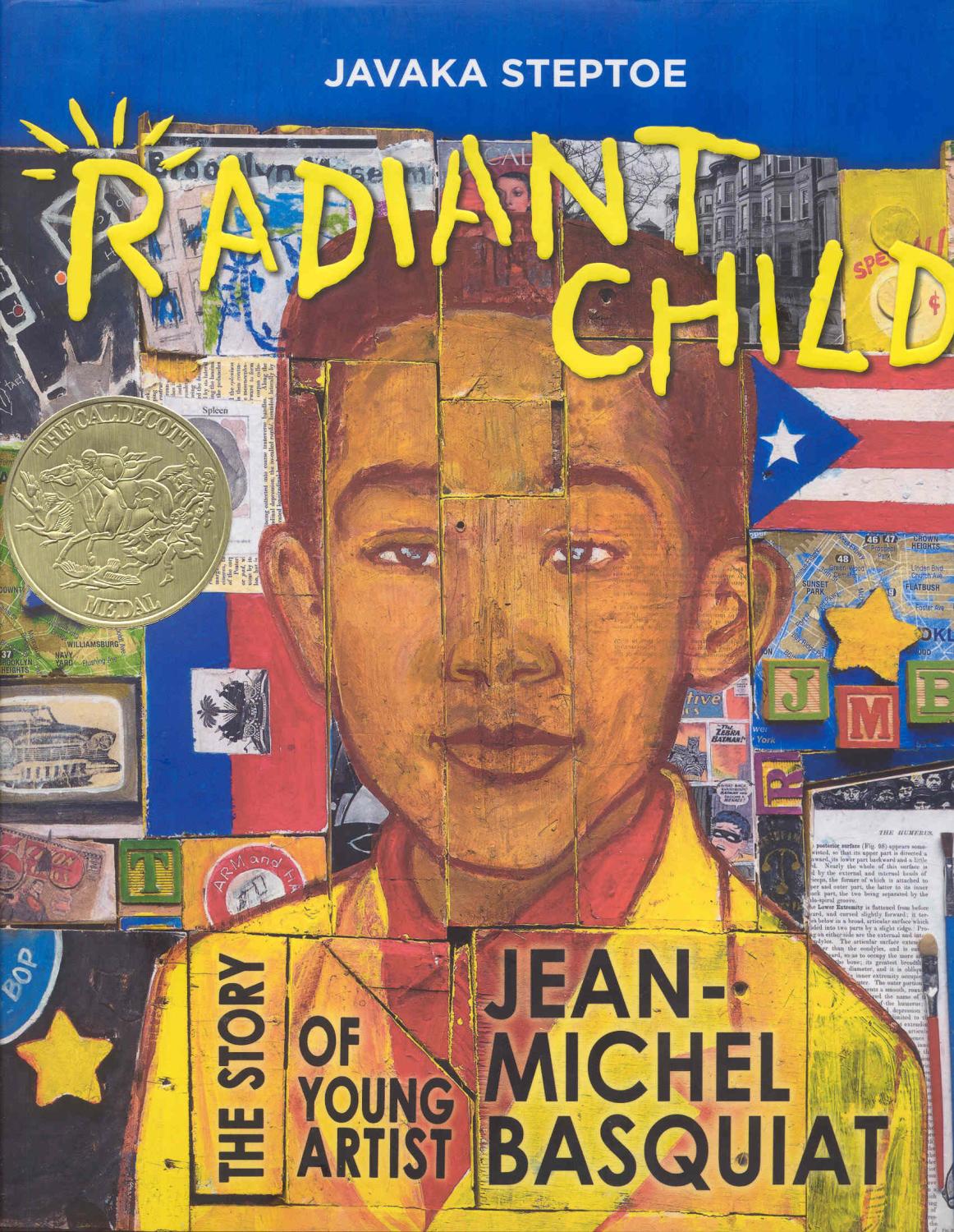
Radiant Child Book Cover, image retrieved from: http://www.abebooks.com

Steptoe, J. (2017). Radiant child. New York, NY: Little, Brown Books.

Age Range: 4 – 8 years
Grade Level: Preschool – 3
Lexile Measure: 1050L

Response

Radiant Child: The Story of Young Artist Jean-Michel Basquiat is a visually striking and moving introduction to the influential contemporary artist Basquiat. The author and illustrator, Javaka Steptoe, prevails in successfully marrying his collage-based artistic style with the heavy-lined technique of Basquiat’s to create a bold children’s book that stands out from the typical bright, sweet colors of children’s books. The presentation of Basquiat’s dreams and ambition to become an artist are inspiring to the reader, and the additional, unexpected themes of the story will captivate and surprise the reader.

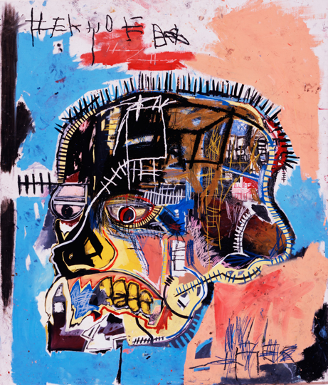
I am familiar with the artwork of Basquiat, and I have viewed approximately a dozen of his pieces in museums in Los Angeles and New York. His work is not one that feels “kid-friendly”. His paintings are raw, and overwhelming in size and emotion. Disruptive, chaotic, dark, despair, and frustrated are all words I would use to describe Basquiat’s paintings. Somehow, Steptoe brilliantly finds the feelings and messages in Basquiat’s work and life that can be portrayed in a children’s book. My favorite excerpt from the book, which also serves to describe the style of illustrations, is “his drawings are not neat or clean, nor does he color inside the lines. They are sloppy, ugly, and sometimes weird; but somehow still BEAUTIFUL” (p.6).

Untitled Portrait, Jean-Michel Basquiat, The Broad

Critique

The story in Radiant Child raises the themes and ideas of determination, pursuing your dreams, mental health problems, diversity, what can be considered art, the creative process, appreciation, healing, and struggle…just to name a few. The story follows Basquiat from his childhood to adulthood while noting the major events in Basquiat’s life; these events are included for perspective on how and why Basquiat creates art in his particular fashion. Every page covers a new life event, accomplishment, set-back, or revelation. You begin to feel the relevance of statements made by Basquiat through his art when you read about his life. It is wonderful to experience the richness of Steptoe’s version of Basquiat’s life.

Lesson

Objective: After reading Radiant Child, the student will identify how the themes in the story were illustrated by the author and create an illustration depicting one of the story’s themes.

Lesson Sketch: Read Radiant Child; preview a few of Basquiat’s original artworks; compare the similarities of Steptoe’s illustrations to Basquiat’s; discuss the themes of the story and how they are illustrated; student will complete an illustration depicting one of the themes from the story with pastels and mixed collage (similar to the artistic style of Basquiat and Steptoe).

Discussion questions:

How did the illustrations and story make you feel?

Why do you think Basquiat wanted to be an artist more than anything?

What challenges in Basquiat’s life inspired him to create art?

Resources

The Broad’s Collection of Jean-Michel Basquiat’s Artwork

Lesson Plan Idea to Accompany Reading of Radiant Child

Video: The Chaotic Brilliance of Artist Jean-Michel Basquiat by Jordana Moore Saggese

Touchstone Book

Cover of The Giver, by Lois Lowry. Image Credit: www.amazon.com

Lowry, L. (1993). The giver. New York, NY: Houghton Mifflin Harcourt.

Usage Information

The Giver, 1994 Newbery Award Winner; Genre: Fiction/Science Fiction/Fantasy Fiction; Age Range: 12 and over; Grade Level: 7-9; Lexile Range: 760L

Response

The Giver illustrates a dystopian reality that might occur if society decides to pursue a world without variation or freedom of choice. The story felt as if we were experiencing a communist ideology that was taken too far. The story is reminiscent of novels I read in high school, such as: A Brave New World by Aldous Huxley , 1984 by George Orwelll, and Fahrenheit 451 by Ray Bradbury. Like all great science fiction dystopia novels, The Giver provides an eerie insight into how certain ideals and points of view should not be applied to society because most of the beauty and love would be forsaken in the process. We cannot live a life that is restrictive and predetermined. Humans desire adventure, wonder, and the unknown. I feel it is necessary for students to read books such as The Giver because they can enlighten young minds as to how society can be affected by science and certain ideologies.

Critique

The Giver is a science fiction and dystopian fiction novel that does not disappoint the reader. The author spends the first half of the novel (110 pages) introducing you to the characters, their “utopia”, and their way of life. I believe this was an effective approach to stage the story. The reader feels curious about what will happen to the main character, Jonas, and concerned about how the overly structured society will influence Jonas. The story is from the point of view of Jonas, who is a twelve-year-old boy, but his observations and insights make the reader feel as if he is mature and level-headed for his age. The author uses brilliant descriptions to illustrate the memories that Jonas receives from the giver. I felt as if I too could see the snowy mountain and feel the warmth of a Christmas gathering with Jonas. I think a class lesson could reflect on the words and language used to portray the vivid memories.

There are numerous themes throughout the story which could be used for discussions while reading the novel; the one I felt was brilliantly illustrated is the coming of age realizations about life and society. Jonas begins to see the world for what it truly is, and it is scary, ugly, and hard to bear at times. This is an awakening that most of us experience once we witness and learn of the faults in society and mankind. He has been sheltered, as are many people in our society. Jonas struggles with how to reconcile the knowledge he has been given. Students in middle school and high school will identify with Jonas and his adolescent battles. One way to manage the stress and frustration is to find the beauty, love, and peace in life. Which is another inspiring theme in the novel. Jonas realizes this and it drives him to find a new way of life because he cannot return to the veiled point of view. It would be interesting to hear student’s reactions to Jonas’ choices in the novel. Would they have the same reactions and choices?

Lesson Ideas

Objective: After reading The Giver, the student will be able to complete two written activities reflecting on and analyzing themes and ideas in the novel.

CCSS.ELA-Literacy.RL.8.2: Determine a theme or central idea of a text and analyze its development over the course of the text, including its relationship to the characters, setting, and plot; provide an objective summary of the text.

Lesson Activities: 1. Write five “memories” about our current society and world that you would share with Jonas to make him aware of how different his world is from ours. Use detailed descriptions to illustrate the “memory”. 2. Write two page essay exploring three main themes from the novel and how they develop.

Discussion Questions:

  1. How does the society in The Giver differ from our society? How is it the same?
  2. What qualities does Jonas possess that make him a viable “receiver”?
  3. What do you think will happen at the end of the story? (question to be asked before the last two chapters).

Resources

Santa Ana School District Extensive Lesson Plan ideas for The Giver

Scholastic Lesson Plan for The Giver

The Giver Lesson Plans

Avatar Activity

I created this avatar of myself in Avatar Maker , it was fairly easy and quick to design. It looks like a younger, prettier version of me, but, nonetheless, it bears some resemblance. I found the avatar entertaining to create, and this program had a myriad of variations to make the avatar resemble the person as much as possible, such as enlarging facial features and adjusting the colors to one’s preference. The free program offers different backgrounds, which helps add a little artistic-flare to the image.

This quick activity can be used in a classroom so students could use an avatar to communicate and post online, rather than use an image of themselves; this would help in maintaining a child’s anonymity and protect their identity. I believe students would enjoy creating a cartoonesque version of themselves.

Introduction- Science in the 21st Century

Hello Everyone! My name is Trisha Cupples and I am in my Junior year of the Bachelor’s Degree Program for Educational Studies. I spent the last 15 years working as a paralegal. I was a preschool teacher and nanny when I was younger, and I attended college to become a teacher, but I never completed my degree. My children inspired me to make the change and pursue my dream of being a teacher. I believe I would like to teach Fourth – Sixth grade, but I have a strong interest in art, so I have struggled with the decision because part of me would like to be a high school art teacher.

Developing skills on how to teach Science to the next generation is extremely important to me! My interest in learning scientific facts and processes started at a young age when I dreamed of becoming an astronaut. Throughout my youth I became captivated with marine biology, astronomy, chemistry, physics, and environmental science. I believe the correct applications of science can solve the majority of lives obstacles. Students should be inspired to pursue their interest in science and have many outlets to explore scientific procedures while attending school. Our universe is infinitely incredible and mysterious, and the study of sciences can provide one with new perspectives on just how amazing everything actually is.

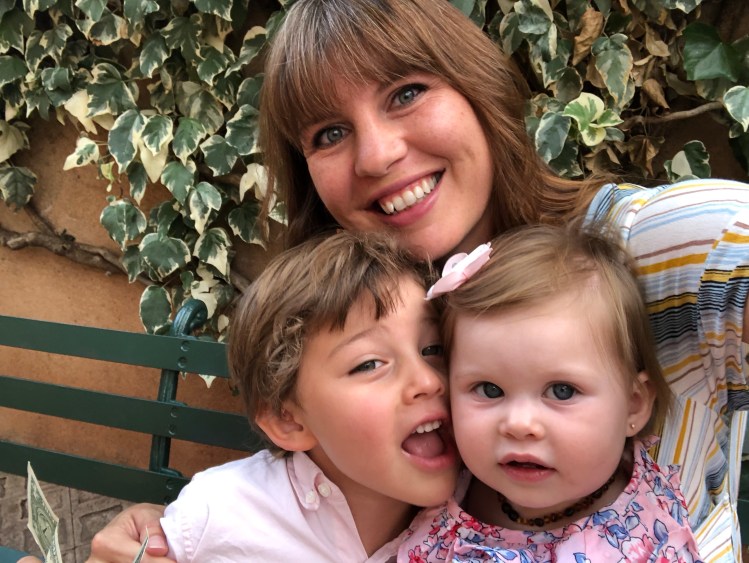
I am married and have two children. Adrian is 4 and Aurelia is 1. We love to travel the world, sing, do art projects, look at art murals and take photos in front of them, search for the best cookies, and go to museums.

I have been painting and doing photography for 20 years. I prefer to oil paint, but it is hard to find the time these days. I have a side-business doing family and wedding photography. I love to share my passion for art with my children, and I hope to incorporate my talents into my teaching.

Design a site like this with WordPress.com
Get started